From trauma to proud!
We only prick when he is ready.
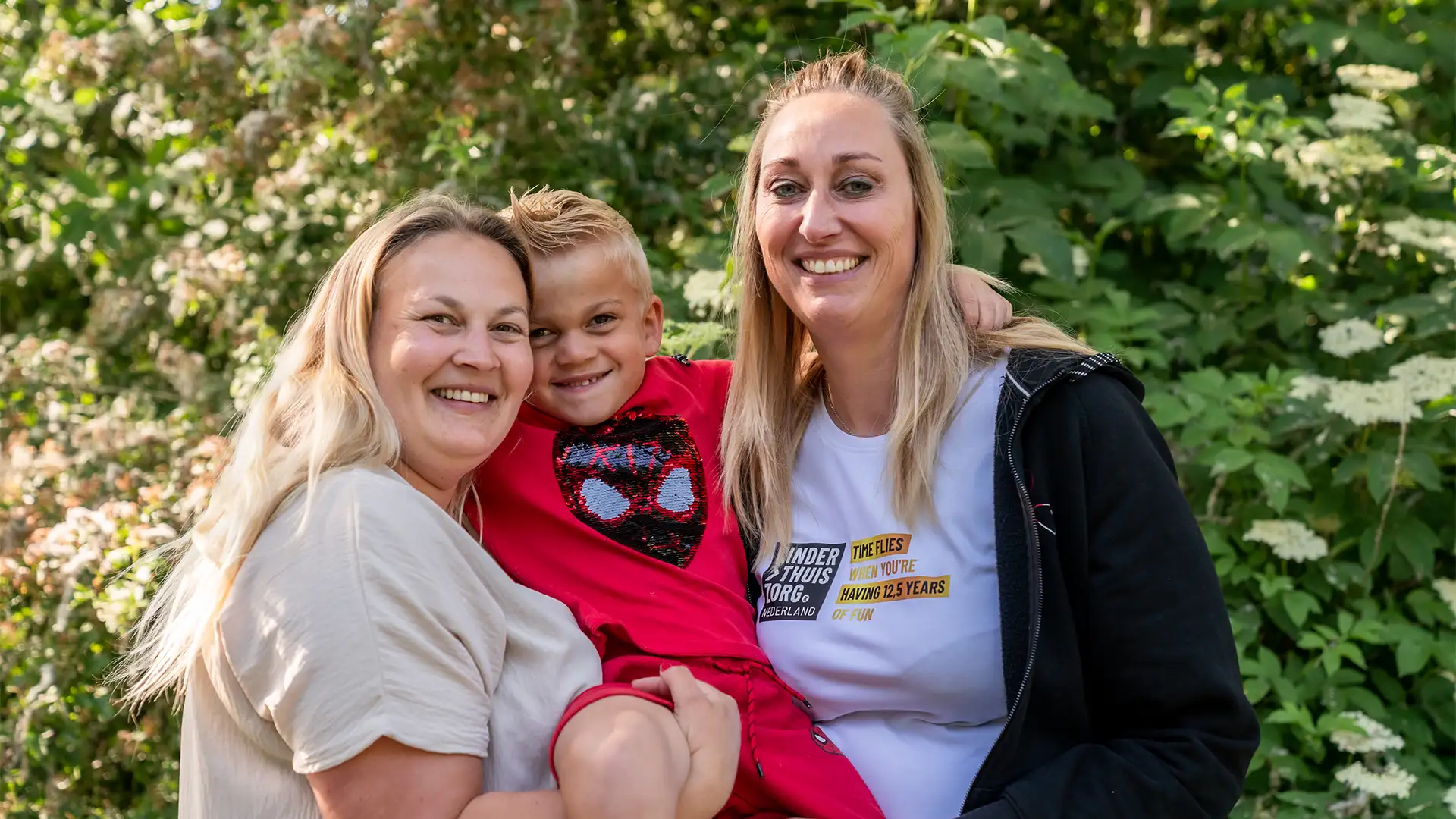
Harvey is almost six, a cheerful child with a strong will. He has a metabolic disease. Every week he is pricked at home for enzyme therapy. This went well for a long time, until he became afraid of the weekly needle. Mother Kelly looks back on this period.
"Mommy!" he called, as I stood in the hallway. "Come on. Look, he's already in there!" I barely kept dry when I saw that he was beaming with pride. Beforehand, he said, "You go down the hallway, Mom. That was his own idea: I didn't have to be there, he just did it alone. Without his mother. Eveline looked at him, asked if he was ready, and there went the needle. After months of struggle, Harvey had succeeded in a few strokes."
"That's because of Eveline, the nurse at KinderThuisZorg. Because of her and her team, Harvey managed to get rid of his fear of needles. 'This is not what we should be doing,' she said one day. Eveline saw our struggle. 'I always took Harvey on my lap when he needed to be prodded. But Harvey is very strong. And he has a strong will. He refused to sit still, hit me, kicked his legs and even bit me once."
"'We have to go back to zero,' Eveline said. 'Starting over and only poking until he's ready. That can only be done by talking, she said, even if that talking takes half an hour. Patience, that was the secret. At the hospital, where they obviously have much less time, they tried to distract Harvey with videos, but that didn't work. Harvey would not be distracted. As soon as he saw the needle, he resisted."
"I relied on my motherhood and went to the hospital"
"Harvey has a rare metabolic disease, which we found out early. Even in the crib I thought: something is not right. Harvey moved little, he didn't turn around. Later, when he started walking, he fell remarkably often. I shouldn't worry too much, said the pediatrician at our local hospital, but I trusted my mother's instincts, and went to the Vumc. There they discovered that he has a rare metabolic disorder. In some children it is not discovered until they are five; Harvey was 2. He had to have enzyme therapy, a lifelong treatment, every week from then on. This is done through an IV into a port-a-carth, a box under his skin. The run-in takes about five hours."
"It went well for a long time, but as he got older he became more aware of what was happening. It also went wrong a few times with pricks, which hurt a lot. He remembered that: the pain, the stress. Afterwards, the Port-a-cath turned out to be crooked, which is why the pediatric nurse pricked next to it. The Port-a-cath had to be removed in the hospital, and Harvey experienced that as traumatic, also because of a bacterial infection, which he contracted earlier and for which he had to receive antibiotics through an IV. From then on, poking became a struggle for Harvey."
"That battle lasted a long time: weeks, months. It went from bad to worse. Until Eveline intervened and decided to put Harvey in charge of prodding. That took some time though. She talked to him a lot, sometimes for half an hour. Harvey felt taken seriously and supported. It was his turn. That worked. Eveline has discussed this in her team and all paediatric nurses of KinderThuisZorg who visit us now do their poking in the same way: only when Harvey is ready. And the great thing is: he is within a few two seconds now. Don't make it a struggle, I would advise other parents going through the same thing. And trust your child."
Text: Nicolline van der Spek